






力扣链接:117. 填充每个节点的下一个右侧节点指针 II,难度等级:中等。
给定一个二叉树:
struct Node {
  int val;
  Node *left;
  Node *right;
  Node *next;
}
填充它的每个 next 指针,让这个指针指向其下一个右侧节点。如果找不到下一个右侧节点,则将 next 指针设置为 NULL 。
初始状态下,所有 next 指针都被设置为 NULL 。
示例 1:
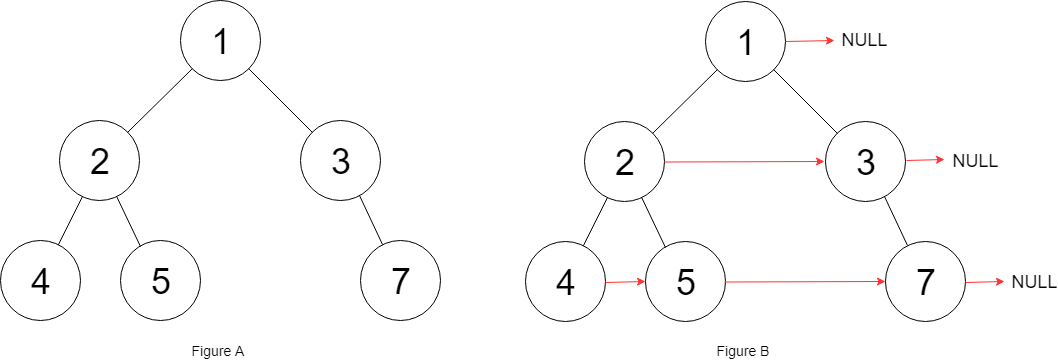
输入: root = [1,2,3,4,5,null,7]
输出: [1,#,2,3,#,4,5,7,#]
解释:
给定二叉树如图 A 所示,你的函数应该填充它的每个 next 指针,以指向其下一个右侧节点,如图 B 所示。序列化输出按层序遍历顺序(由 next 指针连接),'#' 表示每层的末尾。
示例 2:
输入: root = []
输出: []
约束:
- 树中的节点数在范围
[0, 6000]内 -100 <= Node.val <= 100
思路
我们需要连接同一层的节点。使用队列的标准广度优先搜索(BFS)需要 O(N) 的空间。然而,题目要求 O(1) 的额外空间。注意到一旦某一层的 next 指针被完全连接,它就形成了一个链表。我们可以将当前层作为链表进行遍历,找到所有子节点并将它们连接起来,形成下一层的链表。通过为下一层使用一个哑节点(dummy node),我们可以很容易地跟踪下一层的起始位置。
👋 站长寄语:我还为你开发了 coder.id - 打造程序员个人IP, 包含作品集、简历和博客等,助您顺利拿到 Offer!
步骤
- 初始化一个指针
head指向树的root。这代表当前层的起始节点。 - 当
head不为空时进行循环:- 创建一个
dummy节点,作为下一层链表的头节点。 - 使用一个
tail指针(初始指向dummy)来追加子节点。 - 使用
next指针遍历当前层:- 如果
head.left存在,将其追加到tail.next,并将tail向前移动。 - 如果
head.right存在,将其追加到tail.next,并将tail向前移动。 - 将
head移动到当前层的next节点。
- 如果
- 将
head移动到dummy.next,即新构建的下一层的起始位置。
- 创建一个
- 返回原始的
root。
复杂度
时间复杂度
O(N)
空间复杂度
O(1)
解释
- 时间复杂度:
O(N)。我们精确地访问了二叉树中的每个节点一次。 - 空间复杂度:
O(1)。我们在层序遍历中只使用了几个额外的指针(head、dummy、tail),避免了使用队列带来的O(N)空间开销。由于这是迭代方法,因此也没有使用隐式栈空间。
Python #
"""
# Definition for a Node.
class Node:
    def __init__(self, val: int = 0, left: 'Node' = None, right: 'Node' = None, next: 'Node' = None):
        self.val = val
        self.left = left
        self.right = right
        self.next = next
"""

class Solution:
    def connect(self, root: 'Node') -> 'Node':
        # Start with the root node as the head of the current level
        head = root

        while head:
            # Create a dummy node to act as the head of the next level's linked list
            dummy = Node(0)
            # Tail pointer to append children to the next level
            tail = dummy

            # Traverse the current level
            while head:
                # If there is a left child, append it to the next level's list
                if head.left:
                    tail.next = head.left
                    tail = tail.next

                # If there is a right child, append it to the next level's list
                if head.right:
                    tail.next = head.right
                    tail = tail.next

                # Move to the next node in the current level
                head = head.next

            # Move down to the next level
            head = dummy.next

        return root
Java #
/*
// Definition for a Node.
class Node {
    public int val;
    public Node left;
    public Node right;
    public Node next;

    public Node() {}

    public Node(int _val) {
        val = _val;
    }

    public Node(int _val, Node _left, Node _right, Node _next) {
        val = _val;
        left = _left;
        right = _right;
        next = _next;
    }
};
*/

class Solution {
    public Node connect(Node root) {
        // Start with the root node as the head of the current level
        Node head = root;

        while (head != null) {
            // Dummy node to track the start of the next level
            Node dummy = new Node(0);
            // Tail pointer to append nodes to the next level
            Node tail = dummy;

            // Traverse the current level
            while (head != null) {
                // If the left child exists, link it
                if (head.left != null) {
                    tail.next = head.left;
                    tail = tail.next;
                }

                // If the right child exists, link it
                if (head.right != null) {
                    tail.next = head.right;
                    tail = tail.next;
                }

                // Move to the next node in the current level
                head = head.next;
            }

            // Move to the next level (the first node after dummy)
            head = dummy.next;
        }

        return root;
    }
}
JavaScript #
/**
 * // Definition for a _Node.
 * function _Node(val, left, right, next) {
 *    this.val = val === undefined ? null : val;
 *    this.left = left === undefined ? null : left;
 *    this.right = right === undefined ? null : right;
 *    this.next = next === undefined ? null : next;
 * };
 */

/**
 * @param {_Node} root
 * @return {_Node}
 */
var connect = function(root) {
    // Start with the root node as the head of the current level
    let head = root;

    while (head !== null) {
        // Dummy node to track the start of the next level
        let dummy = new _Node(0);
        // Tail pointer to append nodes to the next level
        let tail = dummy;

        // Traverse the current level
        while (head !== null) {
            // If the left child exists, link it
            if (head.left !== null) {
                tail.next = head.left;
                tail = tail.next;
            }

            // If the right child exists, link it
            if (head.right !== null) {
                tail.next = head.right;
                tail = tail.next;
            }

            // Move to the next node in the current level
            head = head.next;
        }

        // Move to the next level (the first node after dummy)
        head = dummy.next;
    }

    return root;
};
Cpp #
/*
// Definition for a Node.
class Node {
public:
    int val;
    Node* left;
    Node* right;
    Node* next;

    Node() : val(0), left(NULL), right(NULL), next(NULL) {}

    Node(int _val) : val(_val), left(NULL), right(NULL), next(NULL) {}

    Node(int _val, Node* _left, Node* _right, Node* _next)
        : val(_val), left(_left), right(_right), next(_next) {}
};
*/

class Solution {
public:
    Node* connect(Node* root) {
        // Start with the root node as the head of the current level
        Node* head = root;

        while (head != nullptr) {
            // Dummy node to track the start of the next level
            Node* dummy = new Node(0);
            // Tail pointer to append nodes to the next level
            Node* tail = dummy;

            // Traverse the current level
            while (head != nullptr) {
                // If the left child exists, link it
                if (head->left != nullptr) {
                    tail->next = head->left;
                    tail = tail->next;
                }

                // If the right child exists, link it
                if (head->right != nullptr) {
                    tail->next = head->right;
                    tail = tail->next;
                }

                // Move to the next node in the current level
                head = head->next;
            }

            // Move to the next level (the first node after dummy)
            head = dummy->next;
            // Prevent memory leak
            delete dummy;
        }

        return root;
    }
};
Csharp #
/*
// Definition for a Node.
public class Node {
    public int val;
    public Node left;
    public Node right;
    public Node next;

    public Node() {}

    public Node(int _val) {
        val = _val;
    }

    public Node(int _val, Node _left, Node _right, Node _next) {
        val = _val;
        left = _left;
        right = _right;
        next = _next;
    }
}
*/

public class Solution {
    public Node Connect(Node root) {
        // Start with the root node as the head of the current level
        Node head = root;

        while (head != null) {
            // Dummy node to track the start of the next level
            Node dummy = new Node();
            // Tail pointer to append nodes to the next level
            Node tail = dummy;

            // Traverse the current level
            while (head != null) {
                // If the left child exists, link it
                if (head.left != null) {
                    tail.next = head.left;
                    tail = tail.next;
                }

                // If the right child exists, link it
                if (head.right != null) {
                    tail.next = head.right;
                    tail = tail.next;
                }

                // Move to the next node in the current level
                head = head.next;
            }

            // Move to the next level (the first node after dummy)
            head = dummy.next;
        }

        return root;
    }
}
Go #
/**
 * Definition for a Node.
 * type Node struct {
 *     Val int
 *     Left *Node
 *     Right *Node
 *     Next *Node
 * }
 */

func connect(root *Node) *Node {
    // Start with the root node as the head of the current level
    head := root

    for head != nil {
        // Dummy node to track the start of the next level
        dummy := &Node{}
        // Tail pointer to append nodes to the next level
        tail := dummy

        // Traverse the current level
        for head != nil {
            // If the left child exists, link it
            if head.Left != nil {
                tail.Next = head.Left
                tail = tail.Next
            }

            // If the right child exists, link it
            if head.Right != nil {
                tail.Next = head.Right
                tail = tail.Next
            }

            // Move to the next node in the current level
            head = head.Next
        }

        // Move to the next level (the first node after dummy)
        head = dummy.Next
    }

    return root
}
Ruby #
# Definition for Node.
# class Node
#     attr_accessor :val, :left, :right, :next
#     def initialize(val)
#         @val = val
#         @left, @right, @next = nil, nil, nil
#     end
# end

# @param {Node} root
# @return {Node}
def connect(root)
    # Start with the root node as the head of the current level
    head = root

    while head
        # Dummy node to track the start of the next level
        dummy = Node.new(0)
        # Tail pointer to append nodes to the next level
        tail = dummy

        # Traverse the current level
        while head
            # If the left child exists, link it
            if head.left
                tail.next = head.left
                tail = tail.next
            end

            # If the right child exists, link it
            if head.right
                tail.next = head.right
                tail = tail.next
            end

            # Move to the next node in the current level
            head = head.next
        end

        # Move to the next level (the first node after dummy)
        head = dummy.next
    end

    root
end
Rust #
// Note: LeetCode does not officially support Rust for TreeLinkNode problems with mutable 'next' pointers easily.
// This is a conceptual implementation using typical interior mutability patterns in Rust.
use std::rc::Rc;
use std::cell::RefCell;

// Definition for a Node.
#[derive(Debug, PartialEq, Eq)]
pub struct Node {
    pub val: i32,
    pub left: Option<Rc<RefCell<Node>>>,
    pub right: Option<Rc<RefCell<Node>>>,
    pub next: Option<Rc<RefCell<Node>>>,
}

impl Node {
    #[inline]
    pub fn new(val: i32) -> Self {
        Node {
            val,
            left: None,
            right: None,
            next: None,
        }
    }
}

pub struct Solution;

impl Solution {
    pub fn connect(root: Option<Rc<RefCell<Node>>>) -> Option<Rc<RefCell<Node>>> {
        if root.is_none() {
            return None;
        }

        // Start with the root node as the head of the current level
        let mut head = root.clone();

        while let Some(current_head) = head {
            // Dummy node to track the start of the next level
            let dummy = Rc::new(RefCell::new(Node::new(0)));
            let mut tail = dummy.clone();

            let mut current = Some(current_head);

            // Traverse the current level
            while let Some(node_rc) = current {
                let node = node_rc.borrow();

                // If the left child exists, link it
                if let Some(left) = node.left.clone() {
                    tail.borrow_mut().next = Some(left.clone());
                    tail = left;
                }

                // If the right child exists, link it
                if let Some(right) = node.right.clone() {
                    tail.borrow_mut().next = Some(right.clone());
                    tail = right;
                }

                // Move to the next node in the current level
                current = node.next.clone();
            }

            // Move to the next level (the first node after dummy)
            head = dummy.borrow().next.clone();
        }

        root
    }
}
Kotlin #
/**
 * Definition for a Node.
 * class Node(var `val`: Int) {
 *     var left: Node? = null
 *     var right: Node? = null
 *     var next: Node? = null
 * }
 */

class Solution {
    fun connect(root: Node?): Node? {
        // Start with the root node as the head of the current level
        var head = root

        while (head != null) {
            // Dummy node to track the start of the next level
            val dummy = Node(0)
            // Tail pointer to append nodes to the next level
            var tail: Node? = dummy

            // Traverse the current level
            while (head != null) {
                // If the left child exists, link it
                if (head.left != null) {
                    tail?.next = head.left
                    tail = tail?.next
                }

                // If the right child exists, link it
                if (head.right != null) {
                    tail?.next = head.right
                    tail = tail?.next
                }

                // Move to the next node in the current level
                head = head.next
            }

            // Move to the next level (the first node after dummy)
            head = dummy.next
        }

        return root
    }
}
Swift #
/**
 * Definition for a Node.
 * public class Node {
 *     public var val: Int
 *     public var left: Node?
 *     public var right: Node?
 *     public var next: Node?
 *     public init(_ val: Int) {
 *         self.val = val
 *         self.left = nil
 *         self.right = nil
 *         self.next = nil
 *     }
 * }
 */

class Solution {
    func connect(_ root: Node?) -> Node? {
        // Start with the root node as the head of the current level
        var head = root

        while head != nil {
            // Dummy node to track the start of the next level
            let dummy = Node(0)
            // Tail pointer to append nodes to the next level
            var tail: Node? = dummy

            // Traverse the current level
            while head != nil {
                // If the left child exists, link it
                if let left = head?.left {
                    tail?.next = left
                    tail = tail?.next
                }

                // If the right child exists, link it
                if let right = head?.right {
                    tail?.next = right
                    tail = tail?.next
                }

                // Move to the next node in the current level
                head = head?.next
            }

            // Move to the next level (the first node after dummy)
            head = dummy.next
        }

        return root
    }
}
其它语言
欢迎贡献代码到 GitHub repo -> 117. 填充每个节点的下一个右侧节点指针 II。感谢!打造你的开发者个人IP
- 📄 简历 + 作品集 + 博客
- 🌐 支持绑定自定义域名
- ✨ 顶级子域名:
https://yourname.coder.id