






LeetCode Python/Java/C++/JS > 203. Remove Linked List Elements > Solved in Java, Python, C++, JavaScript, C#, Go, Ruby > GitHub
LeetCode link: 203. Remove Linked List Elements, difficulty: Easy.
Given the head of a linked list and an integer val, remove all the nodes of the linked list that has Node.val == val, and return the new head.
Example 1:
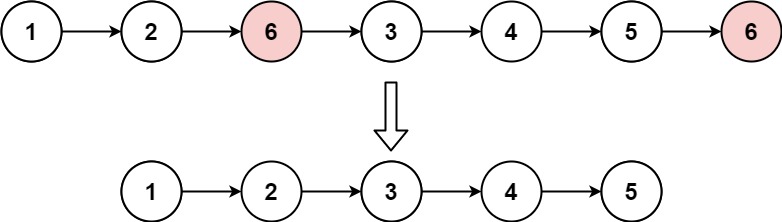
Input: head = [1,2,6,3,4,5,6], val = 6
Output: [1,2,3,4,5]
Example 2:
Input: head = [], val = 1
Output: []
Example 3:
Input: head = [7,7,7,7], val = 7
Output: []
Constraints:
- The number of nodes in the list is in the range
[0, 10000]. 1 <= Node.val <= 500 <= val <= 50
Topics
Intuition
Assume that the node to be deleted in the linked list is
d, and the previous node ofdisp, sop.nextisd.To delete
d, just setp.next = p.next.next.Because
p.next.nextis used, the loop condition should bewhile (p.next != null)instead ofwhile (p != null).But there is no node before the
headnode, which means that theheadnode needs to be treated specially.Is there a way to make the
headnode no longer special? In this way, there is no need to treat theheadspecially.Click to view the answer
The way is to introduce a
dummynode,dummy.next = head.
👋 Hi, I'm the developer behind coder.id — Build your programmer brand. Create your portfolio, resume, and blog in minutes, and land your dream offer!
Complexity
Time complexity
O(N)
Space complexity
O(1)
Java #
/**
 * Definition for singly-linked list.
 * public class ListNode {
 *     int val;
 *     ListNode next;
 *     ListNode() {}
 *     ListNode(int val) { this.val = val; }
 *     ListNode(int val, ListNode next) { this.val = val; this.next = next; }
 * }
 */
class Solution {
    public ListNode removeElements(ListNode head, int val) {
        var dummyHead = new ListNode();
        dummyHead.next = head;
        var node = dummyHead;

        while (node.next != null) {
            if (node.next.val == val) {
                node.next = node.next.next;
            } else {
                node = node.next;
            }
        }

        return dummyHead.next;
    }
}
Python #
# Definition for singly-linked list.
# class ListNode:
#     def __init__(self, val=0, next=None):
#         self.val = val
#         self.next = next

class Solution:
    def removeElements(self, head: Optional[ListNode], val: int) -> Optional[ListNode]:
        dummy_head = ListNode()
        dummy_head.next = head
        node = dummy_head

        while node.next:
            if node.next.val == val:
                node.next = node.next.next
            else:
                node = node.next

        return dummy_head.next
C++ #
/**
 * Definition for singly-linked list.
 * struct ListNode {
 *     int val;
 *     ListNode *next;
 *     ListNode() : val(0), next(nullptr) {}
 *     ListNode(int x) : val(x), next(nullptr) {}
 *     ListNode(int x, ListNode *next) : val(x), next(next) {}
 * };
 */
class Solution {
public:
    ListNode* removeElements(ListNode* head, int val) {
        auto dummyHead = new ListNode();
        dummyHead->next = head;
        auto node = dummyHead;

        while (node->next != nullptr) {
            if (node->next->val == val) {
                auto next_node = node->next;
                node->next = node->next->next;
                delete next_node;
            } else {
                node = node->next;
            }
        }

        return dummyHead->next;
    }
};
JavaScript #
/**
 * Definition for singly-linked list.
 * function ListNode(val, next) {
 *     this.val = (val===undefined ? 0 : val)
 *     this.next = (next===undefined ? null : next)
 * }
 */
var removeElements = function (head, val) {
  const dummyHead = new ListNode()
  dummyHead.next = head
  let node = dummyHead

  while (node.next != null) {
    if (node.next.val == val) {
      node.next = node.next.next
    } else {
      node = node.next
    }
  }

  return dummyHead.next
};
C# #
/**
 * Definition for singly-linked list.
 * public class ListNode {
 *     public int val;
 *     public ListNode next;
 *     public ListNode(int val=0, ListNode next=null) {
 *         this.val = val;
 *         this.next = next;
 *     }
 * }
 */
public class Solution {
    public ListNode RemoveElements(ListNode head, int val) {
        var dummyHead = new ListNode();
        dummyHead.next = head;
        var node = dummyHead;

        while (node.next != null) {
            if (node.next.val == val) {
                node.next = node.next.next;
            } else {
                node = node.next;
            }
        }

        return dummyHead.next;
    }
}
Go #
/**
 * Definition for singly-linked list.
 * type ListNode struct {
 *     Val int
 *     Next *ListNode
 * }
 */
func removeElements(head *ListNode, val int) *ListNode {
    dummyHead := &ListNode{}
    dummyHead.Next = head
    node := dummyHead

    for node.Next != nil {
        if node.Next.Val == val {
            node.Next = node.Next.Next
        } else {
            node = node.Next
        }
    }

    return dummyHead.Next
}
Ruby #
# Definition for singly-linked list.
# class ListNode
#     attr_accessor :val, :next
#     def initialize(val = 0, _next = nil)
#         @val = val
#         @next = _next
#     end
# end

def remove_elements(head, val)
  dummy_head = ListNode.new
  dummy_head.next = head
  node = dummy_head

  until node.next.nil?
    if node.next.val == val
      node.next = node.next.next
    else
      node = node.next
    end
  end

  dummy_head.next
end
Other languages
Welcome to contribute code to GitHub repo -> 203. Remove Linked List Elements. Thanks!Level Up Your Developer Identity
- 📄 Resume, Portfolio & Blog
- 🌐 Custom Domain Binding Supported
- ✨ Premium Subdomain:
https://yourname.coder.id