






LeetCode link: 119. Pascal's Triangle II, difficulty: Easy.
Given an integer rowIndex, return the rowIndexth (0-indexed) row of the Pascal's triangle.
In Pascal's triangle, each number is the sum of the two numbers directly above it as shown:
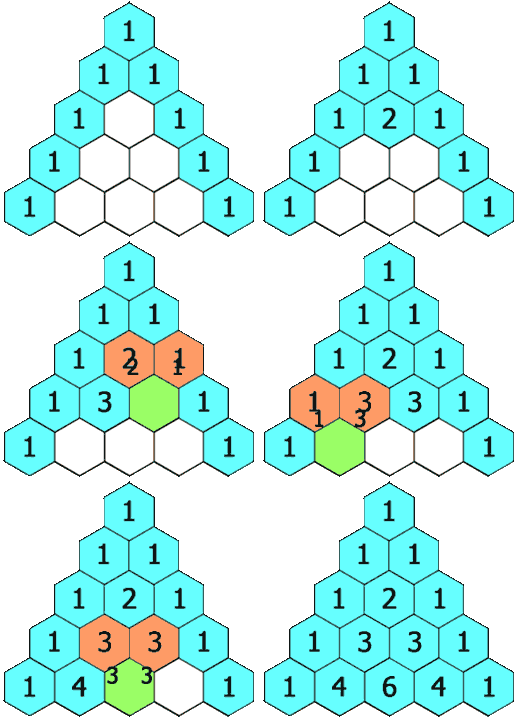
Example 1:
Input: rowIndex = 3
Output: [1,3,3,1]
Example 2:
Input: rowIndex = 0
Output: [1]
Example 3:
Input: rowIndex = 1
Output: [1,1]
Constraints:
0 <= rowIndex <= 33
Topics
Intuition
Each element in a row of Pascal's triangle can be calculated from the previous element in the same row using combinatorics.
The k-th element of the n-th row is given by the combination formula C(n, k).
We can compute C(n, k) based on C(n, k-1) by multiplying it by (n - k + 1) and then dividing by k.
This allows us to generate the entire row in a single pass without needing to compute previous rows.
👋 Hi, I'm the developer behind coder.id — Build your programmer brand. Create your portfolio, resume, and blog in minutes, and land your dream offer!
Step-by-Step Solution
- Initialize an array
resof sizerowIndex + 1filled with 1s. The first and last elements are always 1. - Initialize a variable
prevto 1, representing the previous element C(n, 0). - Loop variable
kfrom 1 up torowIndex - 1. - In each iteration, compute the current element:
curr = prev * (rowIndex - k + 1) / k. It's crucial to multiply before dividing to avoid fractional loss, and use a 64-bit integer type during calculation to prevent overflow. - Store
currinres[k]and updateprev = currfor the next iteration. - Return the
resarray.
Complexity
Time complexity
O(rowIndex)
Space complexity
O(1)
Explanation
- Time Complexity:
O(rowIndex). We only iteraterowIndextimes to compute each element of the required row. - Space Complexity:
O(1)auxiliary space. The problem requires returning an array of sizerowIndex + 1, which is consideredO(rowIndex)space for the output. However, we only use a few extra variables (prev,curr), so the auxiliary space complexity isO(1).
Python #
class Solution:
    def getRow(self, rowIndex: int) -> List[int]:
        # Initialize the result array with 1s.
        # This handles the boundary 1s automatically.
        res = [1] * (rowIndex + 1)

        # Calculate intermediate values using the combination formula
        for k in range(1, rowIndex):
            # res[k] = res[k-1] * (rowIndex - k + 1) / k
            # Use integer division // to ensure we keep integers
            res[k] = res[k - 1] * (rowIndex - k + 1) // k

        return res
Java #
class Solution {
    public List<Integer> getRow(int rowIndex) {
        List<Integer> res = new ArrayList<>();
        // The first element is always 1
        res.add(1);

        // Use long to prevent integer overflow during multiplication
        long prev = 1;
        for (int k = 1; k <= rowIndex; k++) {
            // Calculate next combination value: C(n, k) = C(n, k-1) * (n - k + 1) / k
            long curr = prev * (rowIndex - k + 1) / k;
            res.add((int) curr);
            prev = curr;
        }

        return res;
    }
}
JavaScript #
/**
 * @param {number} rowIndex
 * @return {number[]}
 */
var getRow = function(rowIndex) {
    // Initialize array of size rowIndex + 1 with 1s
    const res = new Array(rowIndex + 1).fill(1);
    let prev = 1;

    // Calculate the values between the boundary 1s
    for (let k = 1; k < rowIndex; k++) {
        // Numbers in JS are double precision floats, safe up to 2^53 - 1
        // The max value in Pascal's triangle for rowIndex 33 is ~1.16 * 10^9, so it's perfectly safe
        let curr = (prev * (rowIndex - k + 1)) / k;
        res[k] = curr;
        prev = curr;
    }

    return res;
};
Cpp #
class Solution {
public:
    vector<int> getRow(int rowIndex) {
        // Initialize vector with size rowIndex + 1 and default value 1
        vector<int> res(rowIndex + 1, 1);
        long long prev = 1;

        // Iterate through the inner elements
        for (int k = 1; k < rowIndex; ++k) {
            // Use long long to avoid overflow when multiplying large numbers
            long long curr = prev * (rowIndex - k + 1) / k;
            res[k] = curr;
            prev = curr;
        }

        return res;
    }
};
Csharp #
public class Solution {
    public IList<int> GetRow(int rowIndex) {
        int[] res = new int[rowIndex + 1];
        // Set the first element
        res[0] = 1;

        long prev = 1;
        for (int k = 1; k <= rowIndex; k++) {
            // Compute the next element using the combination formula
            // We use 'long' to prevent multiplication overflow
            long curr = prev * (rowIndex - k + 1) / k;
            res[k] = (int)curr;
            prev = curr;
        }

        return res;
    }
}
Go #
func getRow(rowIndex int) []int {
    // Initialize the slice with the required size
    res := make([]int, rowIndex + 1)
    res[0] = 1

    prev := int64(1)
    for k := 1; k <= rowIndex; k++ {
        // Calculate current element using int64 to prevent overflow
        curr := prev * int64(rowIndex - k + 1) / int64(k)
        res[k] = int(curr)
        prev = curr
    }

    return res
}
Ruby #
# @param {Integer} row_index
# @return {Integer[]}
def get_row(row_index)
    # Create array initialized with 1s
    res = Array.new(row_index + 1, 1)
    prev = 1

    # Calculate the inner values
    (1...row_index).each do |k|
        # Ruby automatically handles arbitrarily large integers, so no overflow concerns
        curr = prev * (row_index - k + 1) / k
        res[k] = curr
        prev = curr
    end

    res
end
Rust #
impl Solution {
    pub fn get_row(row_index: i32) -> Vec<i32> {
        // Initialize vector with 1s
        let mut res = vec![1; (row_index + 1) as usize];
        let mut prev: i64 = 1;

        for k in 1..row_index {
            // Use i64 for calculation to avoid integer overflow
            let curr = prev * (row_index as i64 - k as i64 + 1) / k as i64;
            res[k as usize] = curr as i32;
            prev = curr;
        }

        res
    }
}
Kotlin #
class Solution {
    fun getRow(rowIndex: Int): List<Int> {
        // Initialize array with 1s
        val res = IntArray(rowIndex + 1) { 1 }
        var prev: Long = 1L

        for (k in 1 until rowIndex) {
            // Use Long to prevent overflow during intermediate multiplication
            val curr = prev * (rowIndex - k + 1) / k
            res[k] = curr.toInt()
            prev = curr
        }

        return res.toList()
    }
}
Swift #
class Solution {
    func getRow(_ rowIndex: Int) -> [Int] {
        // Initialize array of given size with 1s
        var res = Array(repeating: 1, count: rowIndex + 1)
        var prev = 1

        if rowIndex > 1 {
            for k in 1..<rowIndex {
                // Compute using combination formula
                // Standard Int in Swift is 64-bit on modern Apple platforms, avoiding overflow for rowIndex <= 33
                let curr = prev * (rowIndex - k + 1) / k
                res[k] = curr
                prev = curr
            }
        }

        return res
    }
}
Other languages
Welcome to contribute code to GitHub repo -> 119. Pascal's Triangle II. Thanks!Level Up Your Developer Identity
- 📄 Resume, Portfolio & Blog
- 🌐 Custom Domain Binding Supported
- ✨ Premium Subdomain:
https://yourname.coder.id